
The motorcycle wave: where it comes from and how riders do it around the world
The short answer
The motorcycle wave is a small greeting between riders passing in opposite directions, usually a low left hand with two fingers pointing at the road. In some places riders nod instead. Nobody knows for sure where it started, and you should never take a hand off the bars when it isn't safe.
You pass another rider on a quiet road. Their left hand drops from the bar, two fingers point at the tarmac, and they're gone. It's one of the first things new riders notice.
Where the wave comes from
The short answer is that nobody knows. There are stories, and they're good ones, but none is documented history.
The Harley and Davidson story. The most repeated version says that in the early 1900s, around 1904, William Harley and Arthur Davidson passed each other on the road and waved, and other riders copied them. It's a nice story. There's no record that proves it.
The early days story. Another explanation is simpler. When motorcycles were rare and unreliable, riders were more likely to need help from the next rider along. A wave said "I see you" and, by extension, "I'd stop if you needed me."
The two wheels story. The low two-finger wave is usually explained as "keep two wheels on the ground", a wish for a safe ride. Some riders read it as a peace sign turned downwards. Both are interpretations rather than recorded origins.
What matters is what it means now: you're both out there, on the same side.
How to do it
The classic version:
- Make sure the road ahead is clear and you're on a straight.
- Drop your left hand from the bar, low, beside the bike.
- Point two fingers down or out towards the oncoming rider.
- Put your hand back on the bar.
Why the left hand? In countries that drive on the right, it's the hand nearest to oncoming traffic, and the right hand stays on the throttle. In left-hand traffic countries like the UK, the nearest hand is the right one, which is often given as one reason riders there nod instead.
How it differs by country
Customs vary, and they vary within countries too. Take this as a loose guide, not a rulebook.
| Where | What you'll often see |
|---|---|
| Most of continental Europe | The low left-hand wave or two fingers to the side |
| UK and Ireland | A nod, sometimes a sideways tilt of the head |
| France | The V to other riders, and a leg out to thank drivers who move over |
| United States | A low wave, with more variation between bike scenes |
| Busy cities anywhere | Very little waving, there are too many bikes |
The French leg out is worth knowing. When a car moves aside to let you past, riders there often stick out a leg, usually the right one, as a thank you. Do it slowly and away from the car so it can't be mistaken for anything else. Elsewhere, a raised hand or a nod does the same job.
When not to wave
Safety comes first, always. Skip the wave:
- In a corner or on a hairpin.
- When braking, changing gear or filtering.
- In heavy traffic or at junctions.
- When the road surface is poor or wet.
- When you're a beginner and it would unsettle you.
Nobody keeps score. A missed wave means the other rider was busy, not rude. If someone doesn't wave back, assume they had their hands full.
Who gets a wave
Officially, any rider. In practice some riders only wave at bikes like their own, and some don't wave at scooters. That's their call, but most riders agree the wave is better when it's for everyone: commuters, 125s, scooters, the person on a 40-year-old bike.
The nod and the wave also work well with riders you'll meet later. Plenty of friendships start with recognising the same bike on the same road every Sunday. If you'd like to ride with them rather than past them, a local group ride is the next step. On MotoBFF, rides sit on a map with their riding level, so you can find one that suits you.
Other signals you'll see
Riders have a few more gestures on the road:
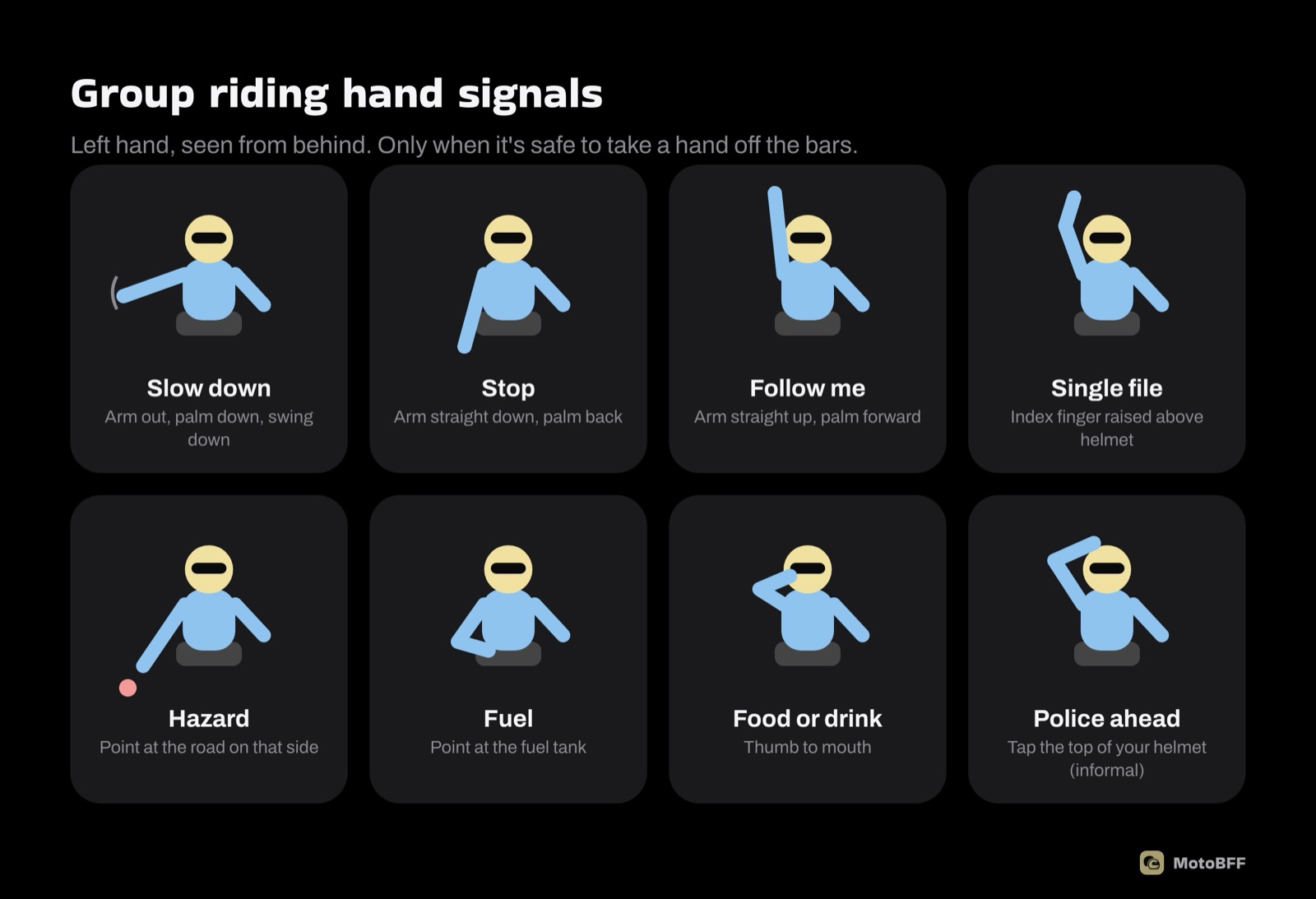
- Tapping the top of the helmet often warns of police ahead.
- Pointing at a tyre or the chain means something's wrong with your bike.
- Pointing at or patting the fuel tank in a group means someone needs fuel.
For the group riding signals, see our guide to formation and hand signals.
Questions riders ask
What does the two-finger biker wave mean?
It's a greeting between riders. Most riders explain the two fingers pointing down as "keep two wheels on the ground", a wish for a safe ride.
Is it rude not to wave back at a motorcyclist?
No. Riders understand that you can't always take a hand off the bars. Safety always comes before a greeting.
Why do motorcyclists nod instead of waving?
Often because their hand is needed on the controls, or because it's the local custom. In the UK the nod is common, and riders often explain it by the hand nearest oncoming traffic being the throttle hand.
Do motorcyclists wave at scooter riders?
Many do and many don't. The wave works best when it's for every rider, whatever they ride.