
Group riding basics: formation, gaps and hand signals
The short answer
Most motorcycle groups ride in staggered formation on straight roads and single file in corners, keep a two-second gap to the rider directly ahead, use a lead and a sweep rider, and use the marker system at junctions so nobody gets lost.
A group ride works when everyone knows the plan without having to talk about it. Here are the basics most groups use. Every group has its own habits, so if a host explains something differently at the briefing, follow the host.
The lead and the sweep
The lead rider knows the route, sets a pace the whole group can ride, and makes decisions at junctions. A good lead rides for the slowest rider in the group, not for themselves.
The sweep rider rides at the back. Nobody overtakes the sweep. If the sweep stops, something has happened, and the group waits. The sweep is usually an experienced rider with a phone, a puncture kit and patience.
Everyone else rides between them.
Staggered formation
On straight roads with enough space, many groups ride staggered: the lead on the left part of the lane, the next rider on the right, then left again, and so on. You keep about a one-second gap to the rider diagonally ahead and two seconds to the rider directly in front on your side.
Staggering gives every rider a clear view ahead and room to move if something happens.
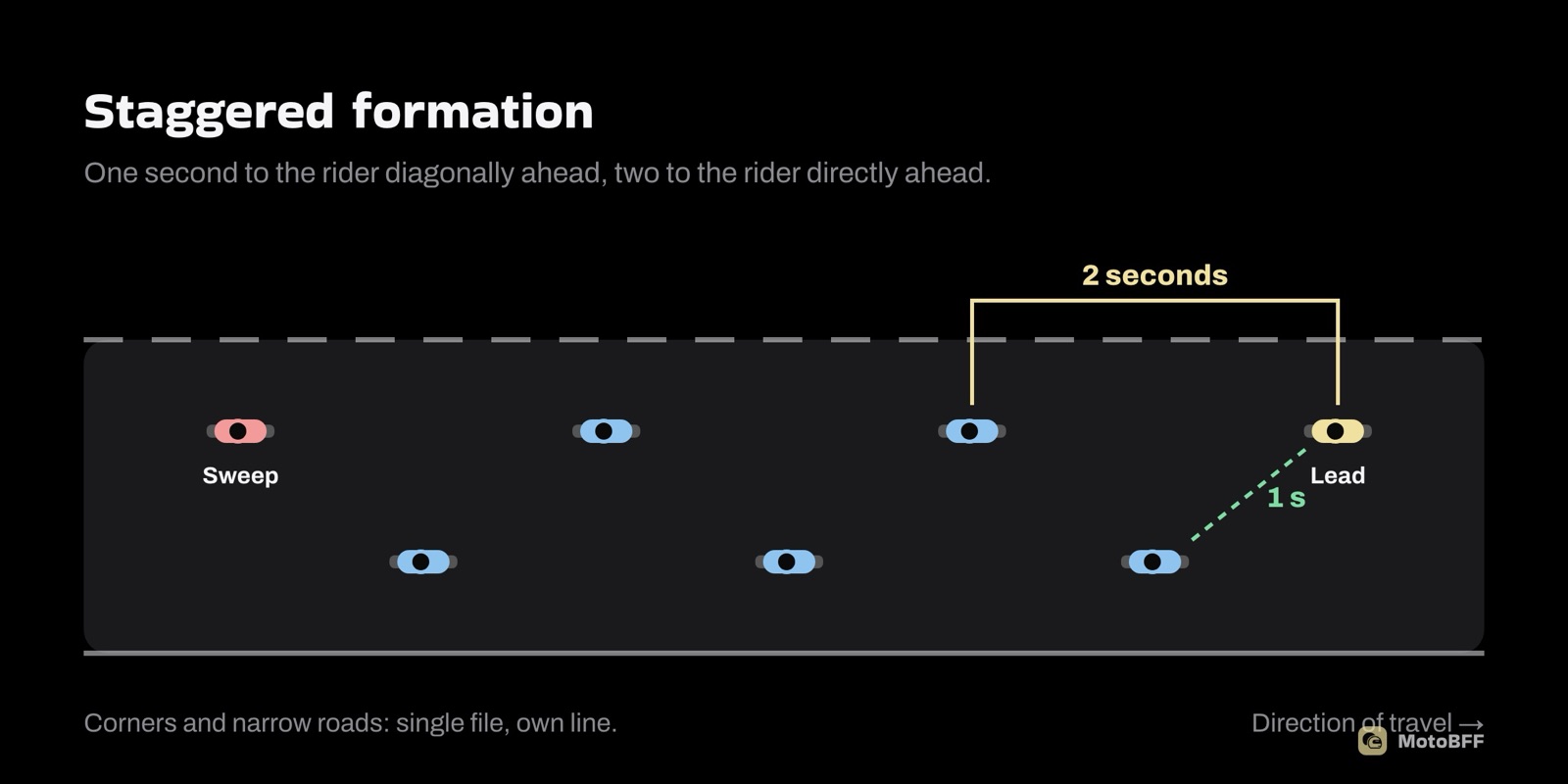
When to break formation: in corners, on narrow or broken roads, in poor visibility and on mountain passes. Then you ride in single file and each rider takes their own line through the corner.
The two-second gap
Pick a fixed point, like a road sign. When the rider in front passes it, count "one thousand one, one thousand two". If you reach it before you finish, you're too close. In the wet, make it four.
Riding close doesn't make the group faster. It makes it nervous.
Junctions: the marker system
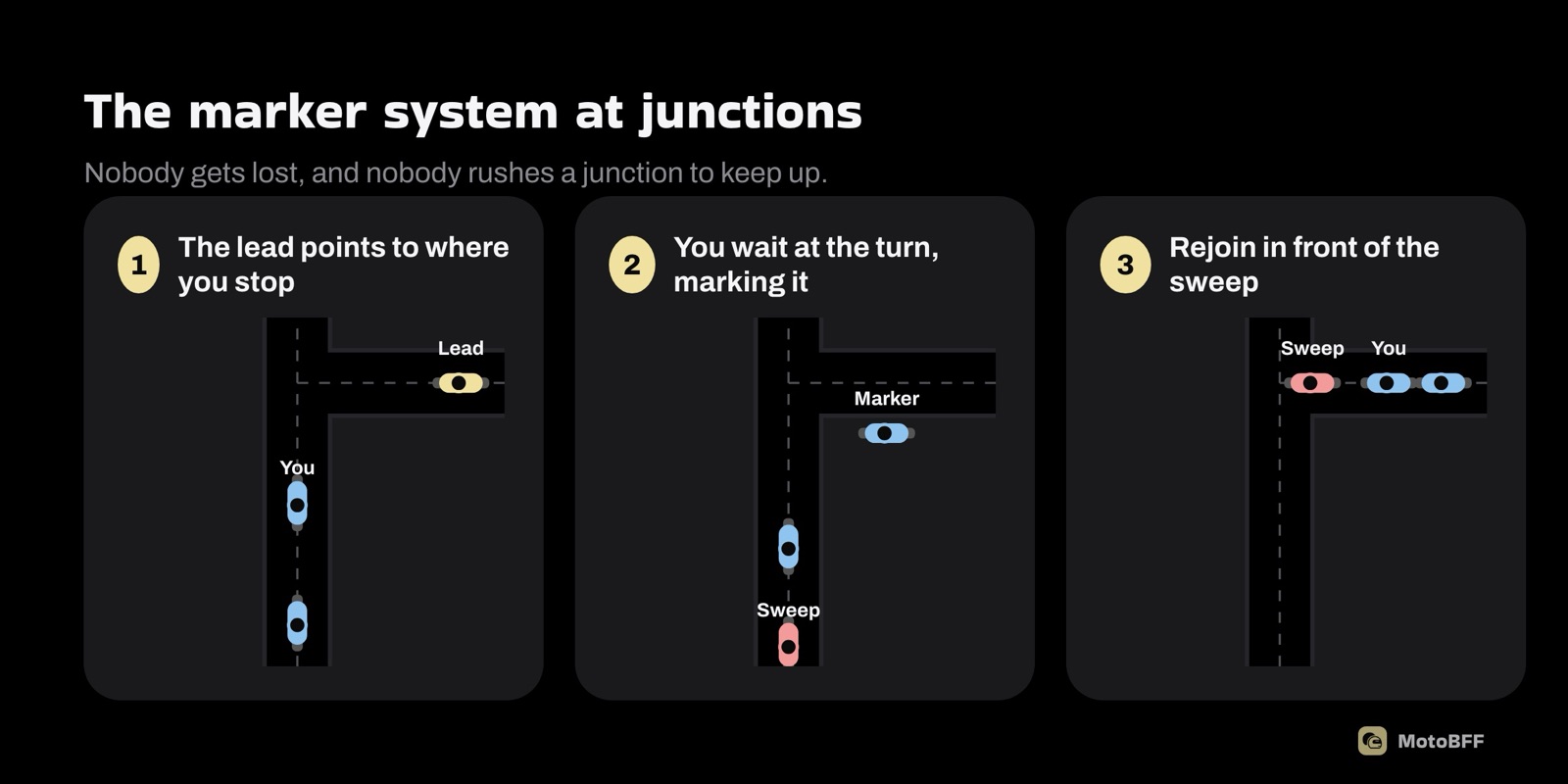
Groups often lose riders at junctions. The marker system (also called corner marking or drop-off) fixes that:
- At a turn, the lead points to the spot where the rider behind should stop.
- That rider pulls over safely and waits, marking the turn for everyone behind.
- When the sweep comes into view, the marker rejoins the group in front of the sweep.
Nobody has to keep the rider behind in their mirrors, and nobody has to rush through a junction to keep up.
Common hand signals
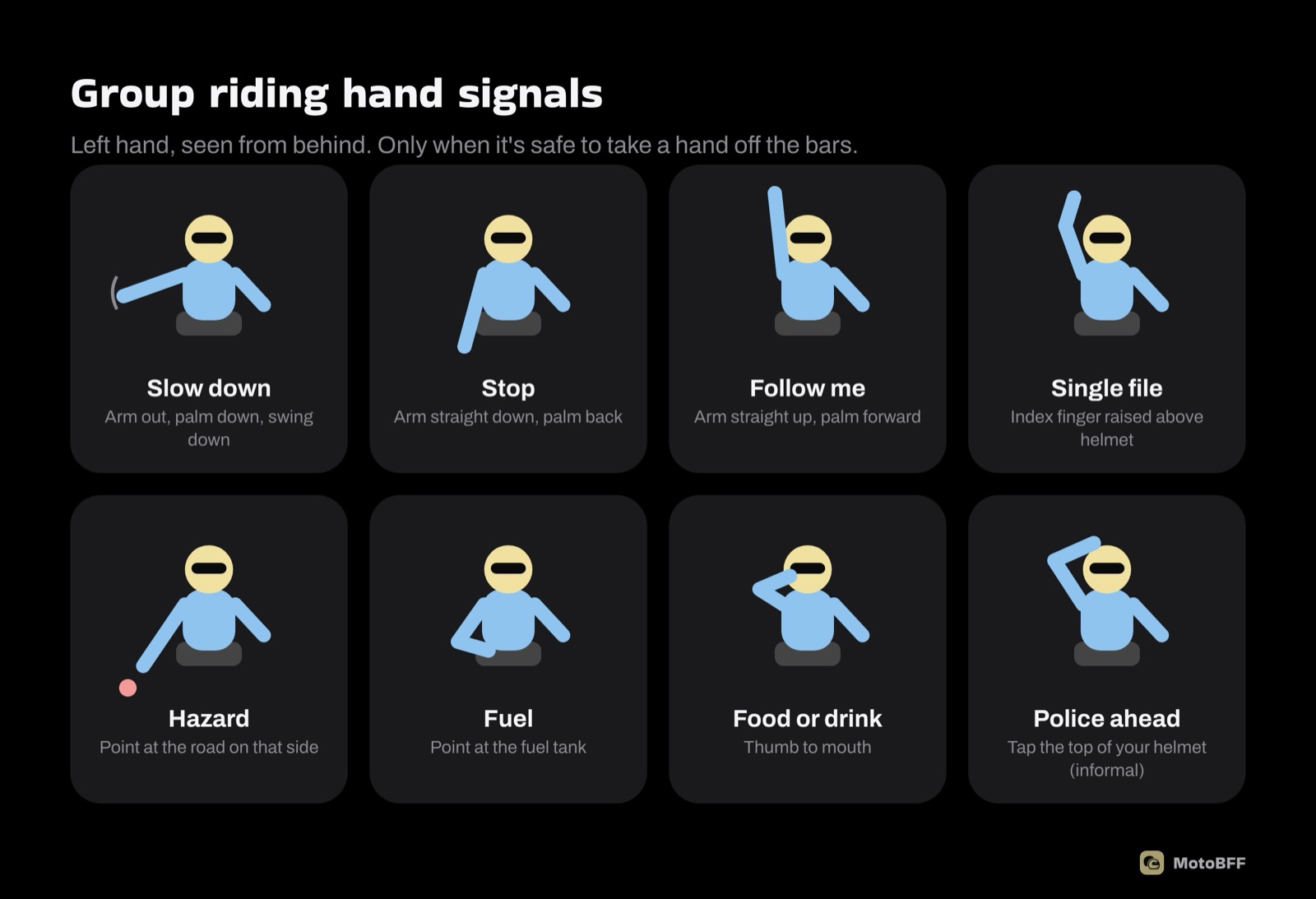
Signals vary by country and by club, so confirm at the briefing. These follow the widely used Motorcycle Safety Foundation set, plus one informal favourite:
| Signal | Meaning |
|---|---|
| Left arm out, palm down, swinging down | Slow down |
| Left arm straight down, palm facing back | Stop |
| Left arm straight up, palm forward | Follow me |
| Left index finger raised above the helmet | Single file |
| Pointing at the road with your left hand (or right foot) | Hazard on the road |
| Pointing at the fuel tank | Need fuel |
| Thumb to mouth, fingers closed | Food or drink stop |
| Tapping the top of your helmet | Police ahead (informal, varies by country) |
Use a signal only when it's safe to take a hand off the bars.
Overtaking
Overtake traffic one at a time, when it's safe for you, not because the rider ahead went. After you pass, move far enough ahead to leave room for the next rider to get in behind you.
Before you start
- Agree the route, the stops and the fuel plan.
- Swap phone numbers with the lead and sweep, or join the ride's group chat.
- Say if you're new to group riding. It's useful, not embarrassing.
In MotoBFF the ride chat has the meeting point as its first message, so everyone has the plan in one place.
The one rule
Everything above is about one rule: ride your own ride. The group adapts to you, not the other way round. If the pace is too fast, drop back. A good group always waits.
Questions riders ask
What is staggered formation on a motorcycle?
Riders alternate between the left and right part of the lane, keeping about one second to the rider diagonally ahead and two seconds to the rider directly in front.
What does the sweep rider do?
The sweep rides at the back, is never overtaken, and makes sure nobody is left behind.
What is the marker system in group riding?
At each turn, the rider behind the lead stops and marks the turn until the sweep arrives, then rejoins in front of the sweep.
What is the hand signal for police on a motorcycle?
In many countries, tapping the top of your helmet means police ahead. Signals vary, so confirm at the briefing.